
Science
Animals and Humans
The children sorted animals into groups based on their diets; herbivores, omnivores and carnivores.
They used ipads to research the different food groups and some examples of each. They then used this to create their own healthy meal, including a main course, drink and dessert (making sure to include a good balance of nutrients).
science


The children looked at the nutrition labels of a range of food items and sorted them into low and high sugar, low and high fat, and shared other differences that they noticed.
science


We discussed what we already know is inside our bodies; blood, muscles, and bones. The children constructed a skeleton and used descriptions to help them label the bones.
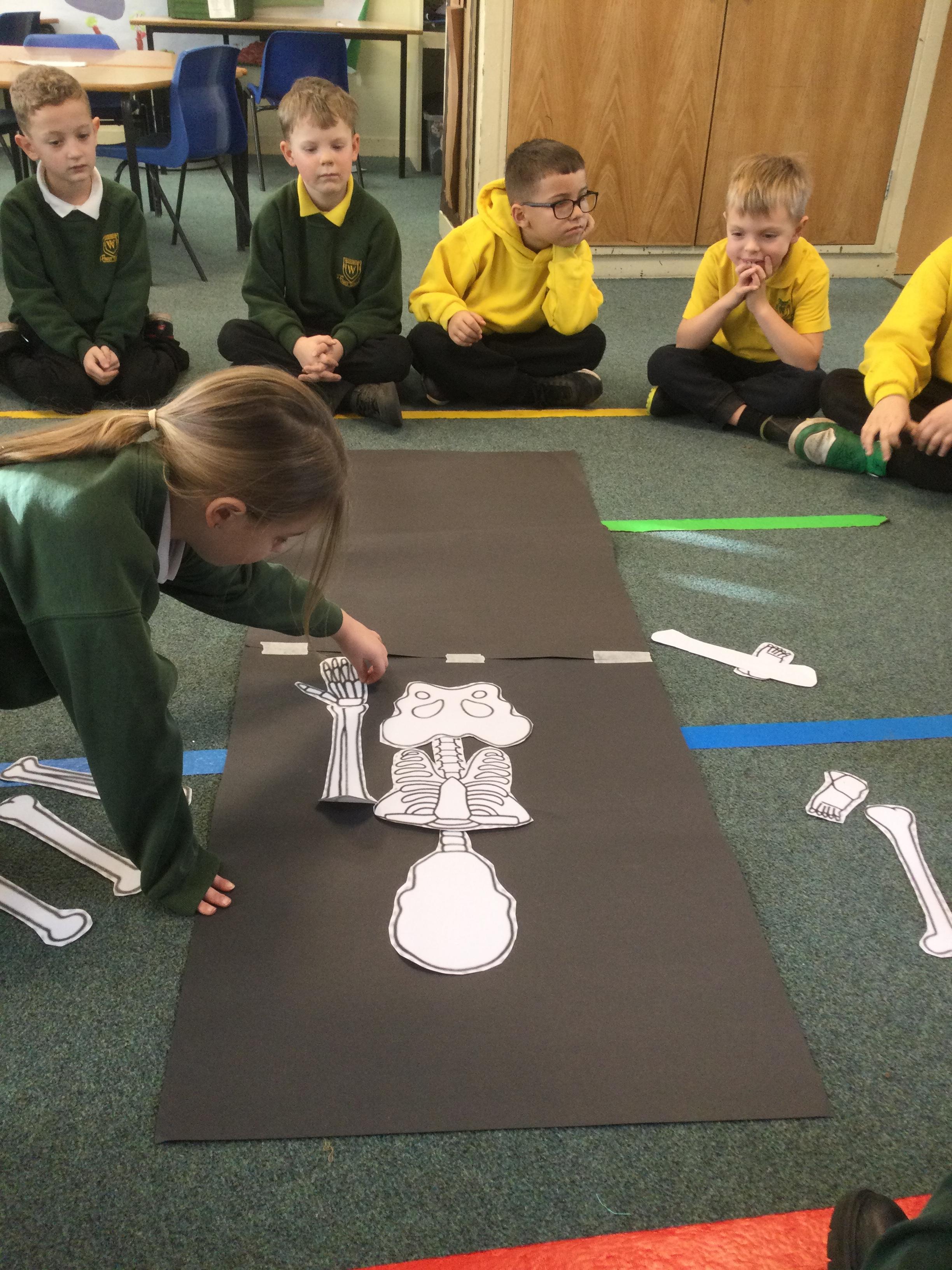
The children discussed the functions of the human skeleton; support, protection and movement and discussed what would happen to our bodies if we didn't have a skeleton.
This led on to our learning about vertebrate and invertebrate animals. The children discussed how we can tell if an animal likely has a skeleton or not, and used x-rays to group animals into vertebrate or invertebrate.
science


Children planned and carried out an experiment to answer the following question:
Do people with longer legs run faster?
1) They planned the materials they would need, made a hypothesis and laid out the method.
2) Measured and grouped children according to the length of their legs.
3) They carried out the experiment, (ran to and from a cone in groups, timing on a stopwatch and recording 1st, 2nd and 3rd place) making sure to keep necessary factors the same (distance ran, number of short, medium and long legs).
4) Displayed the class data on 3 bar charts; one for short legs, one for medium and one for long.
5) Drew a conclusion from the data:
People with longer legs do not run faster, but that we could investigate this further by including more people.
science


Magnets and forces
Throughout this unit of work, 3B have explored:
- which materials are magnetic and addressed the misconception that all metals are magnetic.
- how objects move differently on different surfaces and how friction affects speed.
- how surface type affects distance of megnetism.
- contact and non- contact forces.
- how magnets attract or repel each other and how the poles can predict this.


