
Autumn Mantle - Play Pioneers
On a street, not far from here...
"The story begins on Maple Street. A group children, no older than you, stumbled across somewhere new, a place they had never seen before".
The children watched as Miss Lettice drew a house. A strange looking house with square, circle and triangle windows and a long slim rectangular door. Its garden was a mess. Nuts, bolts, rubbish bags and old toys were strewn across the garden.
The children came and added the things they felt would fit into this messy garden. Over grown plants, cracks in the roof, spider webs and dead flowers. We wondered together, who possibly live in this house?
3 bears? Little Red? A poor family? We really didn't know! We decided to draw and write our ideas and stick them around the drawing of the house.
autumn-mantle---play-pioneers


The Toymakers Rest.
Next to the front door of the cottage, we spotted a plaque. We squinted hard but couldn’t quite work out what it said, for it was covered in dust, cobwebs and ivy.
We paused. One of the children got into role as the plaque. We draped cobwebs and ivy over him to show how unkempt the plaque was.
We then pressed play on our story again and decided to carefully remove the over growth to see what the plaque said.
The ToyMakers rest…
autumn-mantle---play-pioneers


The door.
We decided to knock on the door. A voice called out WHOSE THERE! We freeze framed our feelings at that time. Scared, nervous, worried, excited. We felt so many things. We slowly entered the cottage and saw the old man, sat on his chair. We asked him some questions and discovered his names Mr Maker and he made things for children with his hands in the 60s. We thought about the name of the cottage and what he had told us and decided it was possible he was a toymaker. Suddenly, around him, toys from the past began to appear.
autumn-mantle---play-pioneers


Representing Mr Maker.
We decided to represent Mr Maker. The children decided his clothes should be grubby and dirty, so suggested we take them outside. They had a wonderful time stamping on and dirtying up the clothes. Together we dressed the mannequin. Mr Maker was ready to be part of our story…
autumn-mantle---play-pioneers


Permission to explore the attic.
Mr Maker gave the team permission to explore the attic, but warned them, it had not been opened in a decade. We paused the story and discussed that a decade meant 10 years. We then created a timeline, stretching across the entire classroom and divided it up into decades from 1900 to 2020.
Back in the story, we discussed how we would need to keep our hands free to explore, but would need light. We came up with the idea of making head torches! We quickly got to work.
We used drama to carefully creep up the stairs and into the loft. We noticed it was full to the brim of boxes, old furniture, books and spiders. First, we used freeze frames to represent the various items. We then visually created this together, drawing, cutting and sticking various items onto the attic template.
autumn-mantle---play-pioneers


The journal.
We began to open some of the old boxes. On the top of one, we found an old, dusty, black, leather journal. We understood that this is usually where people write their memories. We opened it up to find it was empty. We decided that to understand more about Mr Makers history, we would create the journal together, using important events from 1960-2020. We then made sure we put the pages in order.
autumn-mantle---play-pioneers


Toys, toys, toys…
We continued to explore the boxes before coming across a bundle of items wrapped in news paper. We decided to carefully open them, not knowing what could be inside. Each bundle was a toy with a year label. We decided Mr Maker must have made these toys. We looked at and compared the materials. Older toys were made of tin, wood and metal. The newer toys were made of plastic. Together we ordered the toys from oldest to newest using our knowledge of decades, and added them to our class timeline. We then decided to create special “past play logs” to record all of our findings. We drew the toys and labelled them with the material and the date they were made.
autumn-mantle---play-pioneers


Restoring Memories.
Deep inside one of the boxes, we discovered an old camera. We turned it on, but discovered there was nothing there. Mr Maker explained that there should be images of key moments from his life…
1965 - Ivan Maker marries Julie.
1966 - Ivan opens his first Toy shop in Redditch.
1970 - Ivan and Julie have their first and only child, a son named. Nigel.
1996 - Ivan wins an award for best toys.
We decided to recreate the photographs for Mr Maker. We began by creating props we would need. A trophy, a baby blanket, a wedding veil and a set of keys. We then freeze framed the photos together.
autumn-mantle---play-pioneers


The last designs…
The team went to present Mr Maker with the photographs, but found him sleeping in his chair. Sticking out of his pocket, they noticed some crumpled paper. They crept and carefully took them from his pocket. After they were unfolded, the team realised they were sketches of toys. A spinning top, a train, a yo-yo and a xylophone.
As Mr Maker awoke, he explained that these were the last toy designs he ever drew. He never got round to creating them as his hands are too shaky and his memory is damaged. The team felt sad for Mr Maker and knew this was important. They decided they would help and promised him they would learn the skills to create the toys for him. They sketched each design into their past play books.
autumn-mantle---play-pioneers


Creating the toys.
The children used their knowledge of "playful making" to create sculptures of Mr Makers last designs. They first began by redesigning them, adding colour and more details. They then used a variety of junk modelling, paper, marbles and cardboard to sculpt their own versions of spinning tops, trains, yo-yos and xylophones. Mr Maker was thrilled with our creations and decided to show the team some more toys. He explained that these toys helped make him successful, but he doesn't remember how or what they were made from. We decided to help by sorting them into wood, metal, fabric and mixed.
autumn-mantle---play-pioneers


The newspaper.
Mr Maker showed us a newspaper, but the heading was all jumbled up. We worked together to re order the heading, which read "The Most Popular Toys of 1965". Together, we represented each page of the paper, ranking each toy from 1st-9th place. Miss Lettice then presented some of the modern day equivalent of each past toy. We decided that hot wheels were similar to Mario kart, Rock em Sock em robots were similar to Xbox games and Cindy dolls were a bit like LOL Dolls. As we were comparing the toys, we noticed some drips of water falling onto the pages...
autumn-mantle---play-pioneers


The muddled scrapbook.
We saw Mr Maker on his chair, looking through some old pages. "My memories! My scrapbook is ruined, its all out of place". We looked at the pages together. All of Mr Maker and Julies memories were there for us to see. We discussed that these were mostly important events from the 1960s. We noticed the moon landing, the Beatles first record, the concord taking flight and even Martin Luther King winning the Nobel Peace Prize. We worked together to re order the pages, using the dates and our timeline to help us. We noticed that the scrapbook was a little wet too...
autumn-mantle---play-pioneers


The leak
After exploring the attic the team discovered a leak in the attic. Out of the story we used art skills to create the leak. We collaged raindrops and used old parts of drainpipe to represent the water flooding through the roof.
autumn-mantle---play-pioneers


The World Wide Web
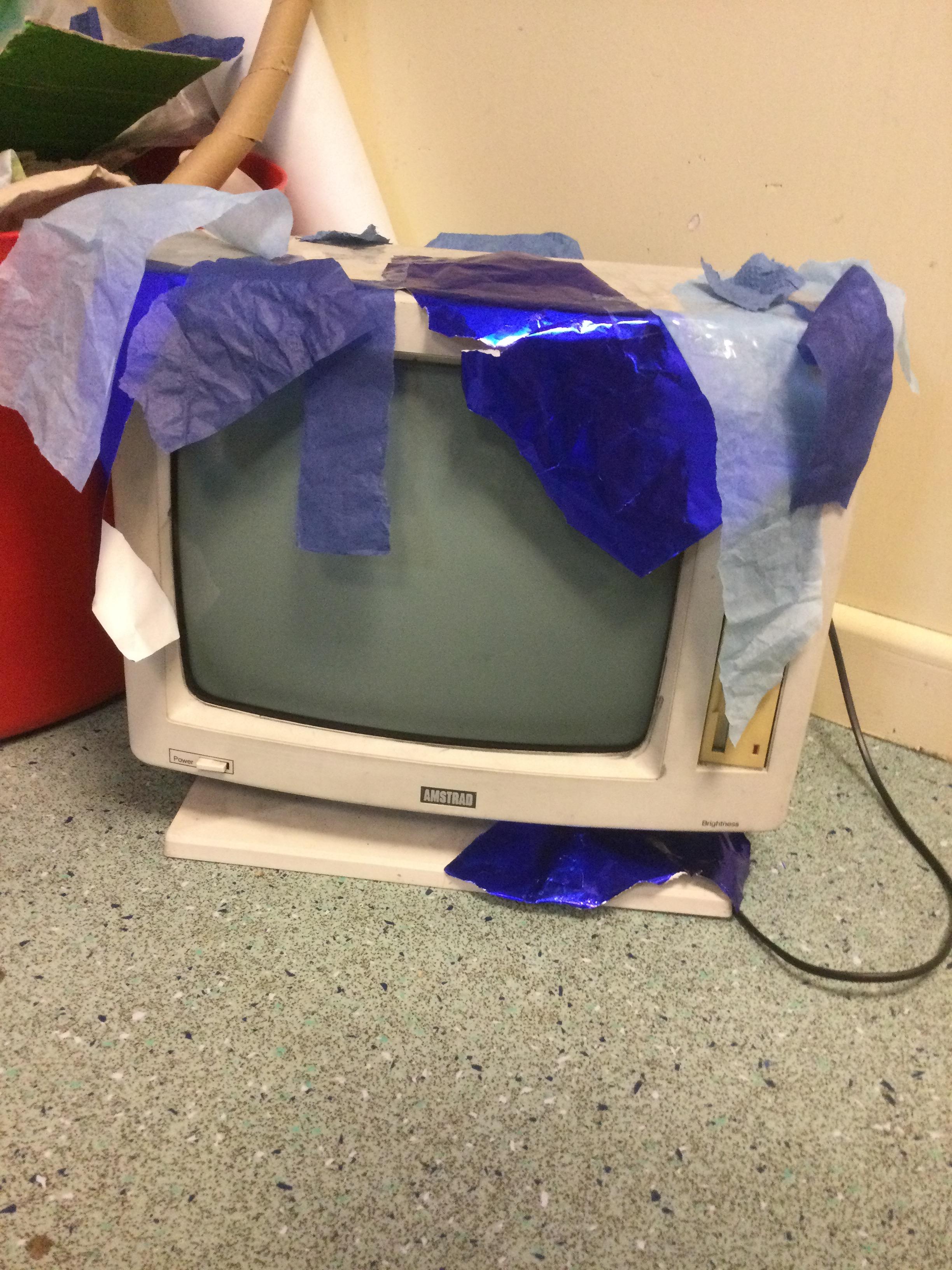
Whilst finding the leak, the team could hear a faint humming from underneath a dust sheet. They decided to look closer and found an old, damaged computer.. We noticed it was covered in water and decided it must have been damaged in the flood. We told Mr Maker, who explained he remembered a time where there was no internet and its invention came from a man called Tim in 1980 something. Because of his memory, he could not remember the details, so we decided to create our own reports about Tim Berners Lee.
Water proof or Not Water proof
We heard the drip drip dripping in the attic. The roof needs to be fixed and fast!
We paused our story and decided we would need to learn some science to help with this part of the story and sport Mr Maker's leak out.
We learnt first about waterproof and not water proof. If something is water poof, water does not go through, if it isn't, it will go through and break or damage the material. We tested a variety of materials (card, foil, stone, plastic and tissue) and discovered which kept the water off by pouring a jug of water.
We discovered that rock, tinfoil and plastic were water proof materials and recorded this on our tick sheets.
autumn-mantle---play-pioneers


A letter to Mr Maker
After discovering which items were water proof and not water poof, we agreed to contact Mr Maker, who was staying with his son, Nigel. We could not text or email, so decided to write him a letter, explaining that we were willing to fix his roof.
The test cottages.
Mr Maker responded to our letter...
Dear Play Pioneers,
Thank you so much for your offer of fixing the leak in my roof. I am so worried about my precious toys and memories getting
ruined. Please get started as soon as
possible!
I have gone to stay with my son, Nigel, and my Granddaughter, Rosie. She was born in 2020. How old does that make her?
Best of luck and thank you,
Ivan Maker.
We discussed together that to help, we need to have tried and tested a range of materials using our science knowledge and decided we would conduct experiments to find out which material will be most effective.
We knew we could not just fix the roof straight away, so decided to create our own paper bag cottage replicas to conduct our experiments on.
autumn-mantle---play-pioneers


The flexibility test
We knew which materials are water proof and not, but for a roof, we also want a material with a little flexibility. We discovered that this meant it will bend a little. We founds samples of the materials we decided were waterproof and conducted a flexibility test, trying to bend each. We recorded the results using a bar chart and ranked each material as "flexible, not flexible and a little bit flexible".
The results showed us that tinfoil was very flexible, the plastic was a little flexible and the rock was not flexible!
autumn-mantle---play-pioneers


Creating the roofs
After gathering all of the data, we decided that foil, plastic, clay/brick and wood were most likely going to be the best material. We carefully selected a material and got to work creating the roofs to add to our model cottages.
autumn-mantle---play-pioneers


Testing the Materials.
Once our roofs were complete, we began to test each roof, in order to make the ultimate decision of which material would be most suitable.
We mimicked a rainstorm, using pipettes to represent light drizzle and a spray bottle to represent a storm. We then rated each material out of 5 stars.
autumn-mantle---play-pioneers


Representing the broken roof.
Before we could fix the roof, we decided we needed to represent Mr Makers cottage, with a real roof to fix. We worked together as a team to create a large cottage. We made individual roof tiles, bricks, curtains and windows, ensuring it looked as much like the photos we had seen as possible. We even included the different shaped windows!


